

Susan Reay on floors, ceilings, and better social work supervision
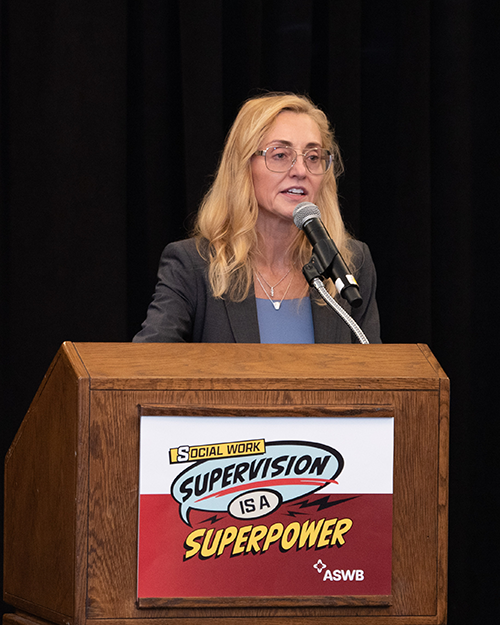
In a presentation grounded in practical experience, humor, and urgency, Susan Reay, Ed.D., LICSW, invited social work regulators at ASWB’s 2026 Education Meeting to think differently about supervision — especially telesupervision — by distinguishing between the “floor” of regulation and the “ceiling” of professional excellence. Drawing on Nebraska’s experience, Reay described how regulators can set enforceable minimum standards while also creating supports that help supervisors and supervisees move toward better practice.
If you want to support people and support social work, you have to really provide a mechanism for them to be able to do it.
Setting a regulatory floor for telesupervision
Nebraska’s geography makes the issue especially pressing. Reay noted that the state covers 77,000 square miles but has only about 3,000 to 3,500 licensees. In many rural communities, she said, telesupervision is not an innovation but a necessity.
“There isn’t a way to get around it,” Reay said. “If you want to support people and support social work, you have to really provide a mechanism for them to be able to do it.”
For Reay, the “floor” is the baseline regulators must establish to protect the public. In telesupervision, Nebraska’s starting point was equivalency.
“If you’re going to do telehealth, make it equivalent to what you would do in person,” she said.
That floor must be clear enough to enforce but not so burdensome that it discourages practice or creates paperwork “that nobody reads.”
Reay cautioned that regulators should consider whether they have the capacity to monitor what they require because overregulation can erode trust and make boards seem punitive rather than supportive.
Building toward the ceiling of supervision quality
At the same time, Reay emphasized that the floor is not enough. The ceiling represents what excellent supervision can become when regulators, educators, and practitioners build pathways to quality. She repeatedly returned to the research finding that supervision quality matters more than quantity.
“It’s about the quality of the relationship,” Reay said, adding that paying supervisors and treating supervision as real work are essential to improving outcomes.
Nebraska’s efforts illustrate how jurisdictions can build upward from the regulatory floor. Reay described free regulatory trainings, telehealth modules, low-cost university-based telesupervision, reflective practice training, a clinical supervision guidebook, and emerging AI tools designed to help supervisors prepare for hard conversations and support supervisees more effectively. Many of these supports are not required by regulation, but they create a culture in which supervisors have practical resources rather than just rules to follow.
Integrating licensure expectations into supervision
A major theme was the need to integrate regulation into supervision itself. Reay explained that supervisors often avoid licensure requirements because they feel uncertain or removed from the process. Her guidebook responds by linking competencies, ethics, regulation, and developmental supervision models. The goal is to make expectations visible from the beginning, so supervisees know where they stand before the end of their hours.
“We have to be clear on where their deficits are, and we have to give them that feedback,” Reay said.
Reay also urged regulators to think beyond complaint-driven oversight. Licensing, she argued, should not be viewed only as a system for discipline. It should also help practitioners improve performance, reconnect with purpose, and strengthen the profession.
“This isn’t just about getting a paycheck,” Reay said. “It’s about improving your performance and doing something, bringing you back to the passion of your career.”
A balanced roadmap for public protection
The presentation ended with a call for practical action. Reay encouraged jurisdictions to identify the minimum standards needed for public protection, then use partnerships, grants, research, training, and technology to build toward the ceiling.
“If the goal here is you want to build better social workers, then we need to figure out the minimum … but also not overregulate,” Reay said.
In that balance — between enforceable standards and aspirational supports — Reay offered a roadmap for regulation that protects the public while helping supervisors and supervisees thrive.