

How one clinical social worker uses supervision to address stereotype threat
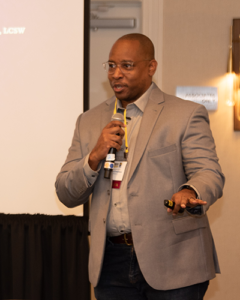
On a recent Zoom call, Dr. Onoriode Evwaraye, Ph.D., LCSW, was surrounded by superheroes. Small plastic ones, but they were posed impressively among his books, revealing his own interest in comic book superheroes.
“With some of my younger [client] populations, I’ve incorporated the comic books…. Especially when I worked in higher education,” he continued. “Sometimes [clients] would describe what they’re feeling by referencing a comic book character and their challenge, and we’ll relate to that. … Basically, it’s a way to ‘backdoor’ into talking about feelings with populations that aren’t normally talking about their feelings.”
Evwaraye left higher education in late 2025 and now has a private practice in the metro Atlanta area. While he currently does not have clinical supervisees, he has supervised many social workers in the past 21 years and sees how supervision is a superpower in developing the next generation of licensed clinical social workers.
Evidence-based clinical supervision and growth mindset
Evwaraye’s approach to supervision, like the rest of his practice, is grounded in evidence-based modalities. He uses a cognitive behavioral therapy lens in his clinical work, and that informs his supervision approach, as well.
“Everything I do is evidence-based,” he said.
Part of his evidence-based approach to supervision is encouraging a growth mindset in his supervisees.
“I intentionally incorporate a growth mindset model into my supervision because when individuals have a growth mindset instead of a fixed mindset, they tend to perform better on standardized exams, they tend to have better psychosocial adjustment, they’re less anxious at work and less likely to have imposter phenomenon.”
The truth is, supervisors are actually in the best position to help early career professionals address those issues. So, if we want to change the field, the people supervising have to be the first line of defense.
Understanding stereotype threat in social work supervision
That emphasis on growth mindset leads naturally to another one of Evwaraye’s specialized areas of expertise: stereotype threat. An encounter with The Bell Curve, a 1994 book by Richard J. Herrnstein and Charles Murray, led Evwaraye down a rabbit hole of research into the literature about different populations’ performances on IQ tests.
“There has to be data out here that explains the performance gap,” he thought. “I stumbled across stereotype threat and then interventions to help stereotype threat. And I incorporated those interventions into my practice on the university campus.”
In practice, stereotype threat refers to the pressure people can feel when they worry that their performance may confirm a negative stereotype about a group they belong to. For students, clients, or early-career social workers, that pressure can become one more thought pattern to notice, understand, and reframe.
That is why, in supervision, “I do a presentation on stereotype threat for my supervisees,” Evwaraye said. “I incorporate it as part of my supervision process, and I also give psychoeducation around the process of stereotype threat. And when I do this, I do it under the guise of ‘You can use this with your clients,’ but the reality of it is that research shows that if you learn about stereotype threat, it reduces the impact of stereotype threat on you.”
“So, I incorporate it into my supervision process. I provide information, and then if [the supervisees] share thoughts or opinions or views or feelings that are consistent with someone who is experiencing stereotype threat, I will help them isolate that thought and reframe that thought, but I’ll do that in the supervision process.”
Simply educating the supervisee about stereotype threat, Dr. Ono points out, inoculates against it to a certain extent.
“It normalizes the experience. … So I do that before we start diving into clinical work. There’s certain ground-level things that I immediately address. I’ll talk about imposter phenomenon and stereotype threat.”
Evwaraye sees a strong tie between his CBT therapeutic approach and including imposter phenomenon and stereotype threat information in his supervision. He can say to his supervisees, “We’ve all been there. I understand why you’re feeling this way. Here’s the research on it. Here’s what we know works to help make it better. And it’s not just for you, but also for your clients.”
“I don’t see how you address stereotype threat without having a framework that’s cognitive-based because [stereotype threat] is a cognitive thing. It’s basically about the thought processes you have, how you got those thought processes, your early schema development, and how that’s impacting your thoughts, which impact your emotions and behaviors. I literally don’t see how you address it without looking at it through a cognitive lens.”
Preparing social workers for clinical licensure
In addition to psychoeducation about stereotype threat and imposter phenomenon, Evwaraye provides accountability to his supervisees as they pursue their clinical licensure. “I’m like, ‘OK, did you sign up? Where are you in the process? What resources are you using? … Are you nervous? Do you have a history of testing anxiety?’ I’m having these conversations throughout [supervision] and also encouraging them to go to the next step.”
With his extensive knowledge of the literature on stereotype threat, Evwaraye believes it, along with imposter phenomenon, should be integrated into training for clinical supervisors.
“The truth is, supervisors are actually in the best position to help early career professionals address those issues. So, if we want to change the field, the people supervising have to be the first line of defense.”